
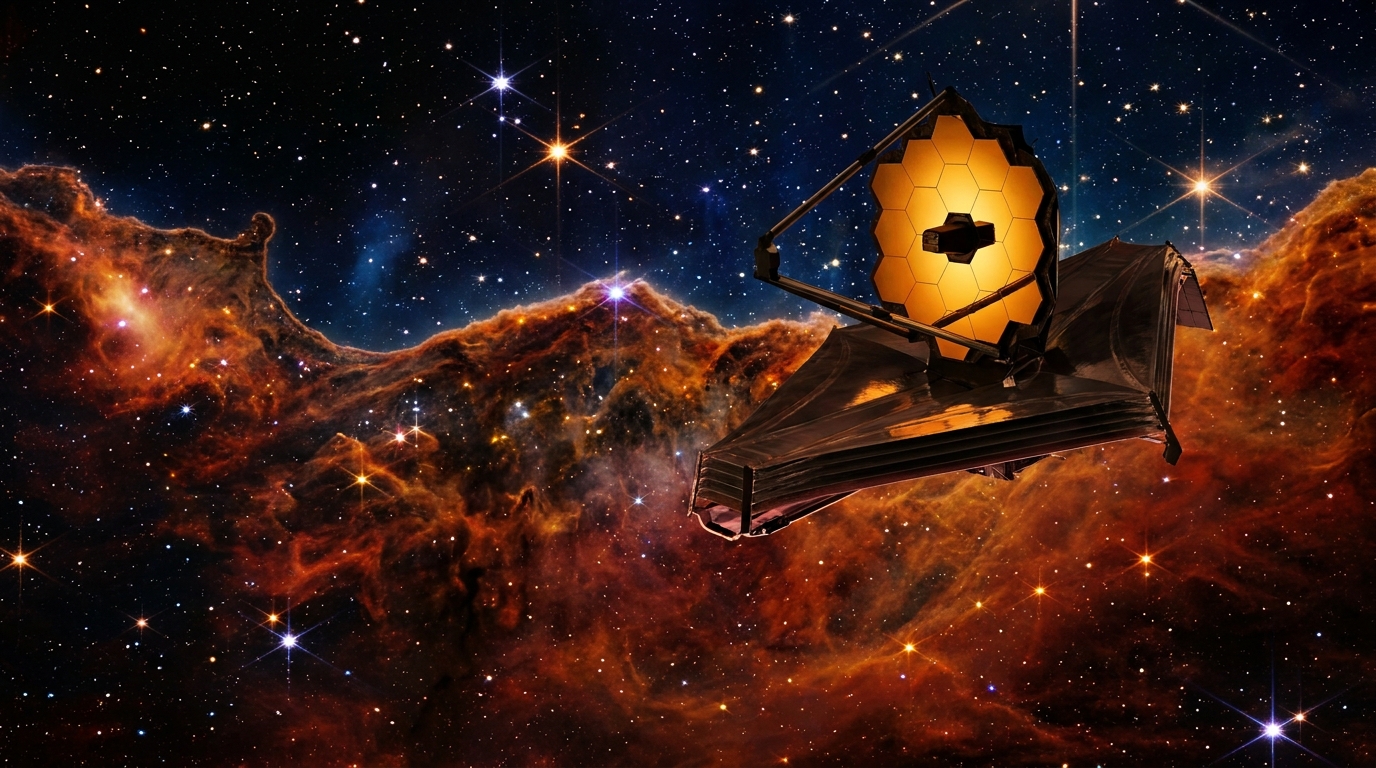
The James Webb Space Telescope confirmed in July 2026 that MoM-z14 is the most distant known galaxy, formed 280 million years after the Big Bang, according to a NASA article. The discovery, 100 times brighter than predicted, adds to observations that are forcing a revision of theories about the origin of the universe.
Wired magazine documents that Webb, operational since 2022, has found objects that do not fit established physics: galaxies too bright, black holes too massive for their age, and the so-called little red dots, tiny red specks that began appearing in large numbers roughly 650 million years after the Big Bang. Faced with this picture, a growing body of research proposes alternative models, though none fully explains what has been observed. For the global scientific community, this public data is raw material for stress-testing current cosmological models, and Mexican astronomy is well-positioned to take advantage of it.
Among the surprises are black holes with one billion solar masses formed just a few hundred million years after the Big Bang, according to Jenny Greene, astrophysicist at Princeton University. The team that confirmed MoM-z14, led by Rohan Naidu of the MIT Kavli Institute, measured a redshift of 14.44, meaning its light traveled roughly 13,500 million years. The team also detected high levels of nitrogen, a feature pointing to supermassive stars and to reionization, the epoch in which light from the first stars pierced the hydrogen fog. NASA expects the Nancy Grace Roman telescope, set to launch in the coming years, to raise the sample of these bright galaxies to the thousands.
With Webb in full operation and Roman on the horizon, astronomers will have more pieces with which to answer when and how the first galaxies formed. The data, open to the international community, give Mexican teams a direct path to contributing to that answer.
This article was drafted with artificial intelligence assistance from verified sources and reviewed by a human editor before publication.