
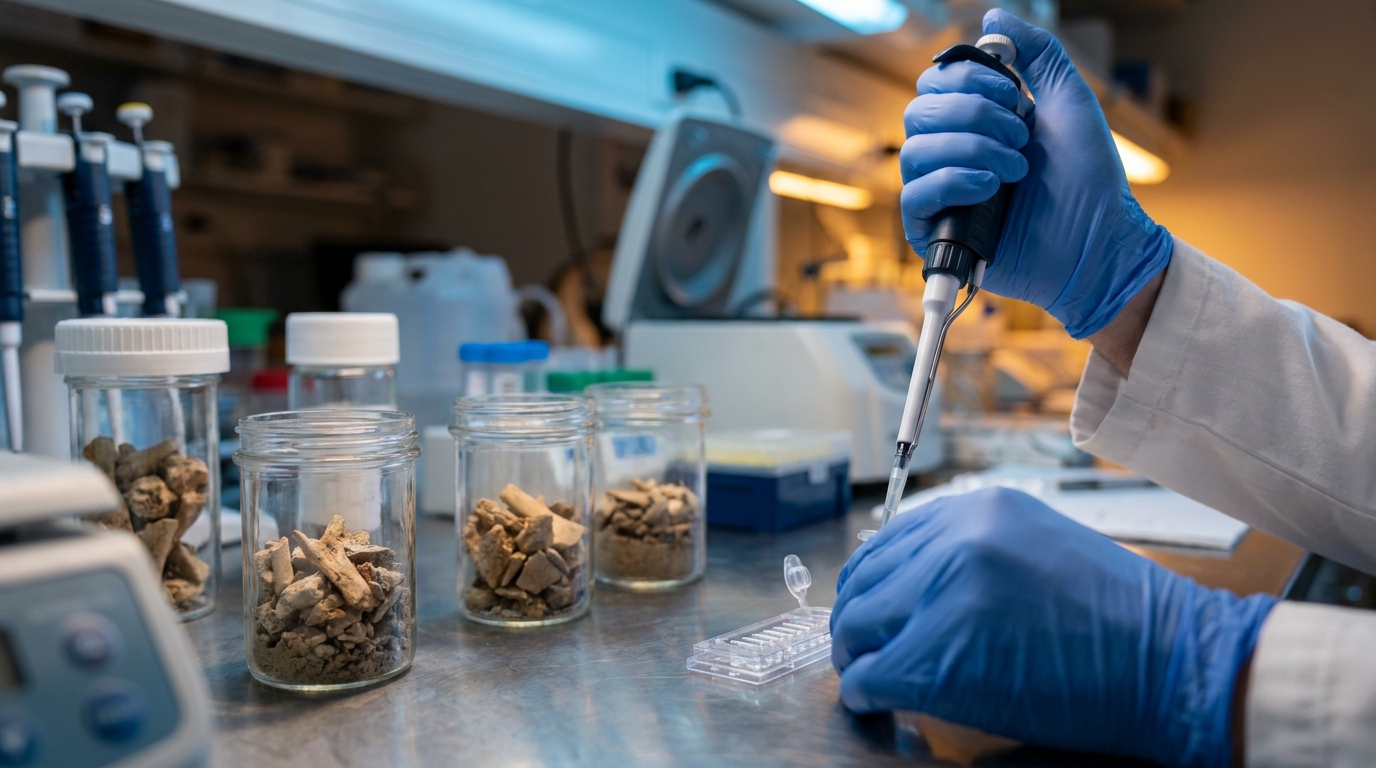
DNA from two indigenous mummies in northern Chile, who lived between 1492 and 1631, yielded the first ancient smallpox genomes ever recovered in the Americas. The finding, published in Science on July 30, 2026, confirms through molecular evidence that the disease arrived on the continent with European colonizers.
The study was led by Bruno Romero González, a doctoral candidate at Trinity College Dublin, with the participation of anthropologist Constanza de la Fuente Castro of the Universidad de Chile. The researchers were analyzing skeletal remains from the Camarones 9 archaeological site in the Arica and Parinacota region, with the aim of reconstructing the population history of the area. The discovery of the virus was accidental: the genetic analysis software detected fragments of smallpox DNA where the team had expected to find only human genomes. For Mexico, where smallpox and other diseases introduced during the Conquest are estimated to have caused an unprecedented demographic collapse in the sixteenth century, the finding delivers the first direct genomic confirmation of a chapter that colonial chronicles described but science had not previously been able to verify.
The two recovered viral genomes share a 99.912 percent identity, indicating that both individuals, an adult woman between 30 and 35 years old and a man between 18 and 20, were infected during the same outbreak or with the same circulating strain. Phylogenetic analysis places this variant on a European branch of the virus's evolutionary tree, with a divergence estimated around the year 1296, as reported by Nature. It represents an intermediate lineage, later than the medieval European strains but earlier than those that gave rise to twentieth-century smallpox. "Nobody would question that smallpox arrived in this hemisphere through colonization, but this proves it," declared Shigeki Nakagome, a geneticist at Trinity College and co-author of the study, according to Scientific American.
Before this discovery, only two pre-twentieth-century smallpox genomes existed: one from seventh-century Viking remains and another from a seventeenth-century Lithuanian mummy. The team now plans to expand the search for pathogenic DNA at other archaeological sites across South America to map with greater precision the route and impact of colonial epidemics on the continent.
This article was drafted with artificial intelligence assistance from verified sources and reviewed by a human editor before publication.