
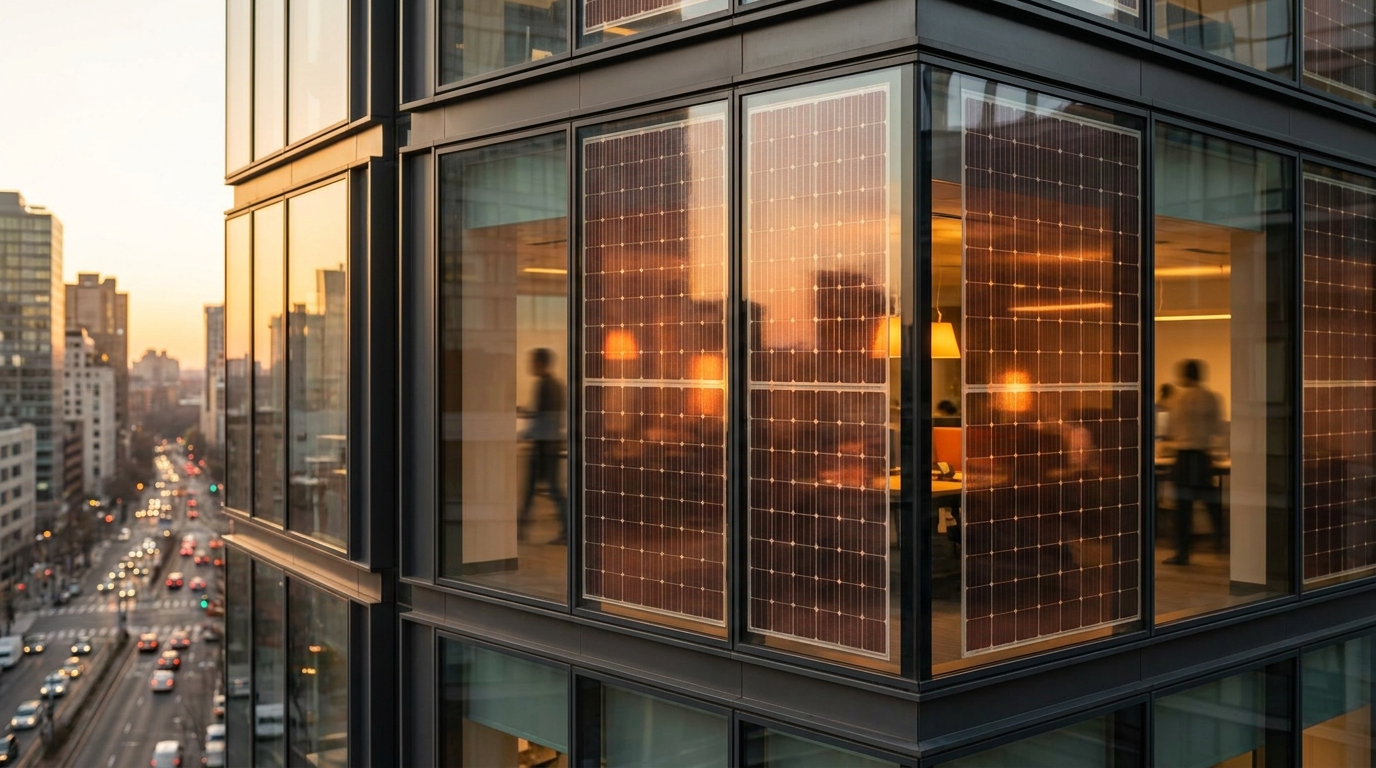
A team at University College London (UCL) developed a semi-transparent glass panel that converts both sunlight and indoor light into electricity, achieving 22% efficiency under intense artificial illumination, the university reported on July 29, 2026.
The prototype, fabricated with perovskite (a semiconductor material tuned to absorb different wavelengths), allows 30% of visible light to pass through while generating power. The findings, published in Advanced Energy Materials in July 2026, open the door to windows, car roofs, and other transparent surfaces functioning as electrical generators without sacrificing their primary purpose, as Investigación y Desarrollo details. For North America, the interest is twofold: in cities across Mexico and the southwestern United States, where air conditioning consumes a significant share of electricity, glass that filters part of sunlight while producing energy helps reduce the thermal load on buildings.
The 30-by-30-centimeter panel uses a perovskite layer just 185 nanometers thick, 500 times thinner than a human hair. The team led by Dr. Mojtaba Abdi-Jalebi, from UCL's Materials Discovery Institute, added a molecule (3-trifluoromethyl-1H-1,2,4-triazole) that reduced electronic defects and stabilized the crystalline structure, and incorporated a transparent gold electrode between two molybdenum oxide layers to maximize light transmission. According to data published by UCL, efficiency reached 22% under intense indoor illumination (1,000 lux) and 14% under direct sunlight, and the device retained 80% of its performance after 300 hours of continuous exposure in accelerated durability tests. Abdi-Jalebi noted that the vast window surfaces of modern buildings remain untapped as an energy resource.
The UCL team aims to move the technology from a laboratory panel to semi-transparent photovoltaic films as easy to install as adhesive window film, opening the path to retrofitting existing buildings without structural work. The full study is available in Advanced Energy Materials.
This article was written with artificial intelligence assistance from verified sources and reviewed by a human editor before publication.