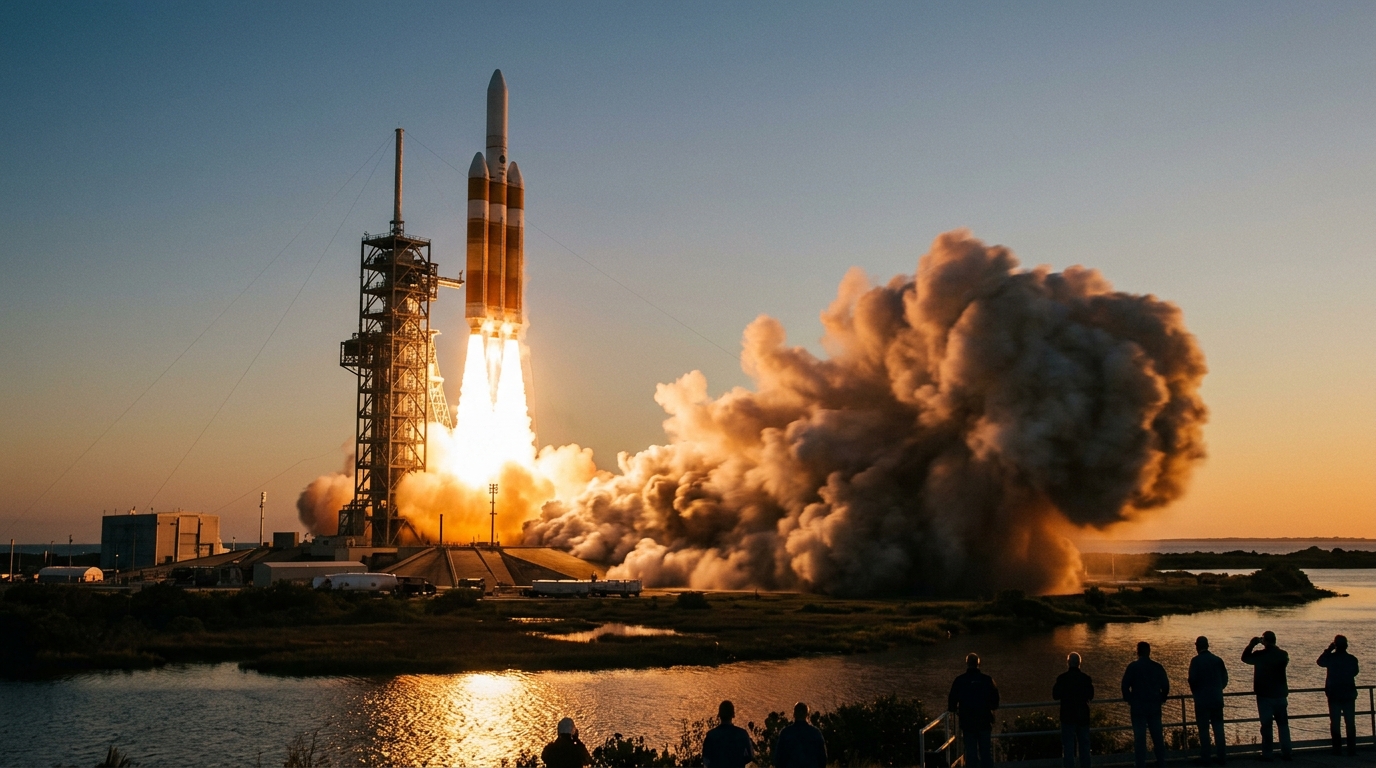
NASA's Nancy Grace Roman Space Telescope launched Sunday, August 30, from Kennedy Space Center in Florida, aboard a SpaceX Falcon Heavy rocket. It is traveling toward Lagrange point L2, one million miles from Earth, where it will map dark matter and dark energy and search for exoplanets.
Roman is the flagship mission succeeding the legacy of Hubble and James Webb. Its 300-megapixel infrared camera will survey the sky one thousand times faster than Hubble, according to NASA, with a field of view more than 100 times larger, according to CNN. The bus-sized observatory required approximately $4.3 billion and more than a decade of development, and includes participation from the space agencies of Europe and Japan. Its name honors Nancy Grace Roman, NASA's first chief of astronomy, known as the mother of Hubble.
The journey to Lagrange point L2, where James Webb also orbits, will take roughly three months. At approximately 1.6 million kilometers away, the gravitational pull of Earth and the Sun balance out, allowing the telescope to hold a stable view of the sky. Mission control at Goddard Center received the first telemetry seven minutes after launch and confirmed solar panel deployment just over an hour later. Over the course of the mission, which may extend to ten years, Roman will transmit 1.4 terabytes of data daily, the highest rate of any NASA astrophysics mission, and the agency anticipates support from artificial intelligence and citizen scientists to review it. Before observations begin, the team will deploy the antenna and protective cover and power on the Coronagraph instrument to test a technology for future searches for Earth-like worlds.
Roman's first images are expected in early 2027. With them will begin the surveys of the next great decade of observational astronomy, a mission designed to detect tens of thousands of unknown worlds. We will cover every milestone along the way.
This article was written with artificial intelligence assistance from verified sources and reviewed by a human editor before publication.