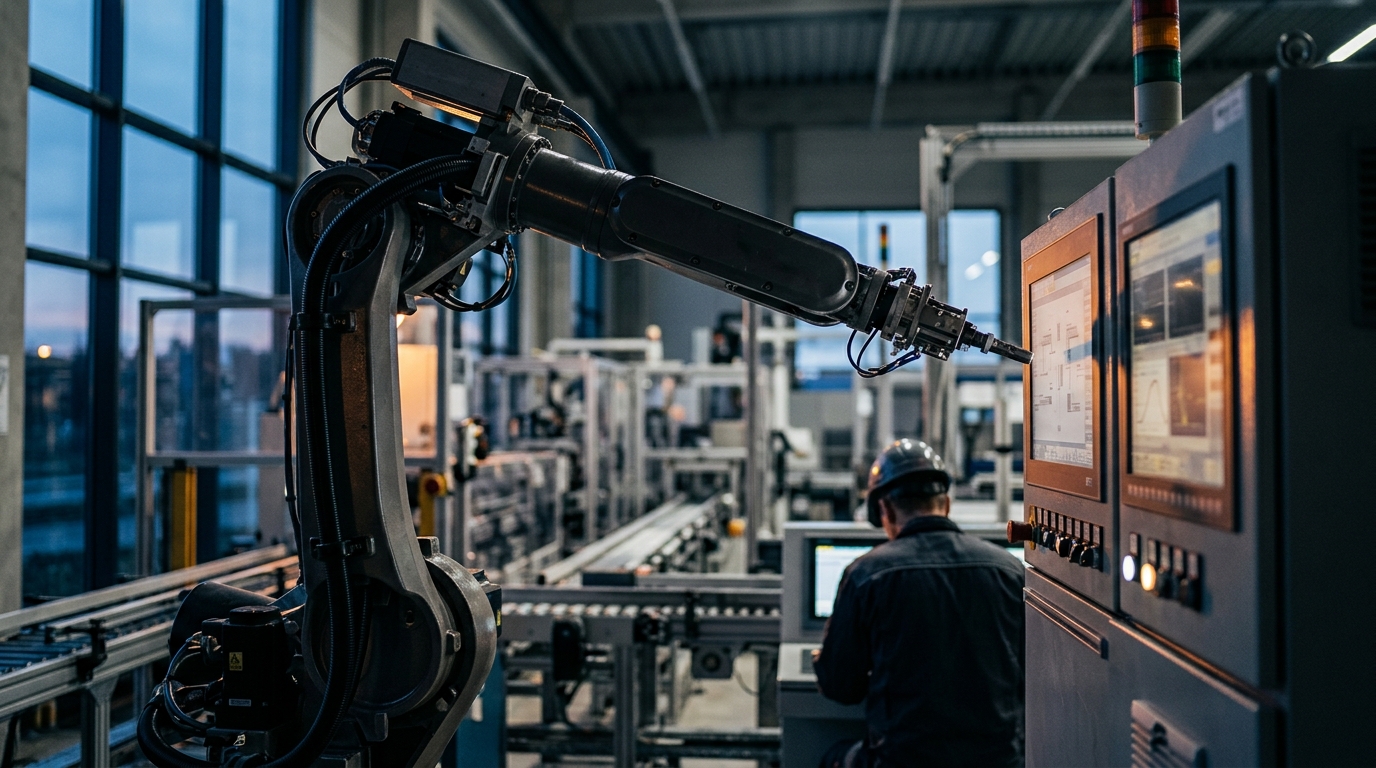
Anthropic presented on Thursday, August 27, 2026 the Model Hardware Standard (MHS), a controller standard that allows artificial intelligence agents to operate microscopes, robotic arms, and advanced manufacturing equipment without custom integrations, according to Ars Technica and CNBC. The company says it reduces experiment setup from weeks or months to hours or minutes.
The announcement arrives as artificial intelligence begins moving from text and code into the physical world. Until now, automation largely happened inside computers; with MHS, an agent can operate any device with a programmable interface, including those used in scientific research and advanced manufacturing. For the Latin community in North America, this matters because Mexico and the United States share one of the continent's most integrated manufacturing chains, with plants and laboratories advancing toward automation in the context of nearshoring. This step follows the Model Context Protocol (MCP), which Anthropic released as open source in 2024 to connect agents with data.
MHS works like a universal connector: devices communicate through a common interface, without a custom translator. The idea originated from observing neuroscientist Arco Bast, of the HHMI Janelia campus in Virginia, coordinating a memory experiment involving rotating lasers, microscopes, and cameras. Alek Kemeny, from Anthropic's technical team, said the idea was to enable artificial intelligence to direct any scientific experiment in the world. Combined with MCP, agents adjust parameters in real time and recover from errors without human intervention. In a test with quantum computing firm QuEra, the success rate for laser recovery went from 58% to 99.3%, according to CNBC. Elizabeth Kelly, an Anthropic executive, said the company built it for science, but that there are also benefits for businesses and industry.
The standard is in a limited research program restricted to a select group of science, robotics, and manufacturing organizations. Anthropic plans to release it as open source, as it did with MCP in 2024, so any device manufacturer can adopt it.
This article was drafted with artificial intelligence assistance from verified sources and reviewed by a human editor before publication.