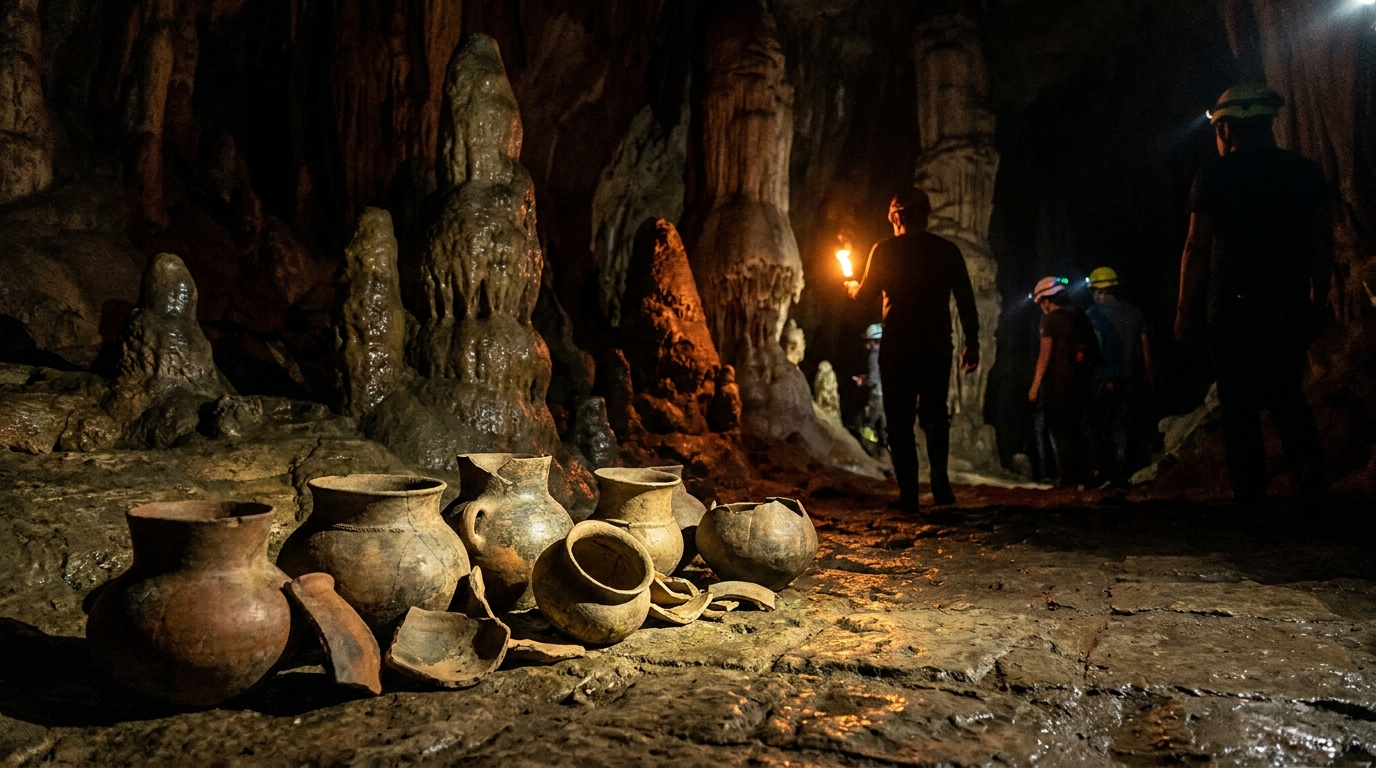
On July 27, 2026, Mexico's National Institute of Anthropology and History (INAH) announced the documentation of 179 pre-Hispanic archaeological artifacts across thirteen ritual deposits inside Cueva Mundo Zoque, in the municipality of Cintalapa, Chiapas. Specialists describe the find as one of the most significant archaeological records of recent decades in southern Mexico.
The cave, situated in the canyon of the La Venta River, was used exclusively for rain-propitiation and agricultural fertility rituals by the ancient Zoque culture during the Late Classic period (600-900 CE), according to INAH. Josuhé Lozada Toledo, a researcher at Centro INAH Chiapas and project lead, described the find as a fundamental contribution to the understanding of the ancient Zoque culture, according to Aristegui Noticias. The site's extreme inaccessibility, requiring a rappel descent of more than ten meters, navigation through narrow corridors, and crossing a siphon passable only during the dry season, kept the location intact and free from looting for centuries. The find was first reported in January 2026 by local guide Jairo Díaz Barreiro and verified by INAH specialists between February and June of the same year, as documented by El Universal.
The documented ceramic pieces include censers, bowls, and effigy urns bearing representations of jaguars, owls, and serpents, animals that in the Zoque worldview symbolize darkness, wisdom, and the cycle of life and death, respectively. A standout piece is a censer decorated with a cross representing the quincunx (the four directions of the universe), its 32-centimeter handle capped with an open-jawed serpent head. Five of the thirteen ritual deposits were recorded in the main chamber, yielding abundant fine-paste orange ceramics. The censers feature ceiba thorns, the sacred tree that marked the ceremonial route into the cave. Stalagmites modified by the ancient Zoques to take on anthropomorphic forms were also identified.
INAH announced that upcoming project phases will include three-dimensional photogrammetry documentation and chemical analysis of the artifacts' interiors to detect residues of copal, ash, or bone. The research, part of the cave documentation and analysis project for the La Venta River canyon, will continue with new explorations in the coming months.
This article was written with the assistance of artificial intelligence based on verified sources and reviewed by a human editor before publication.