
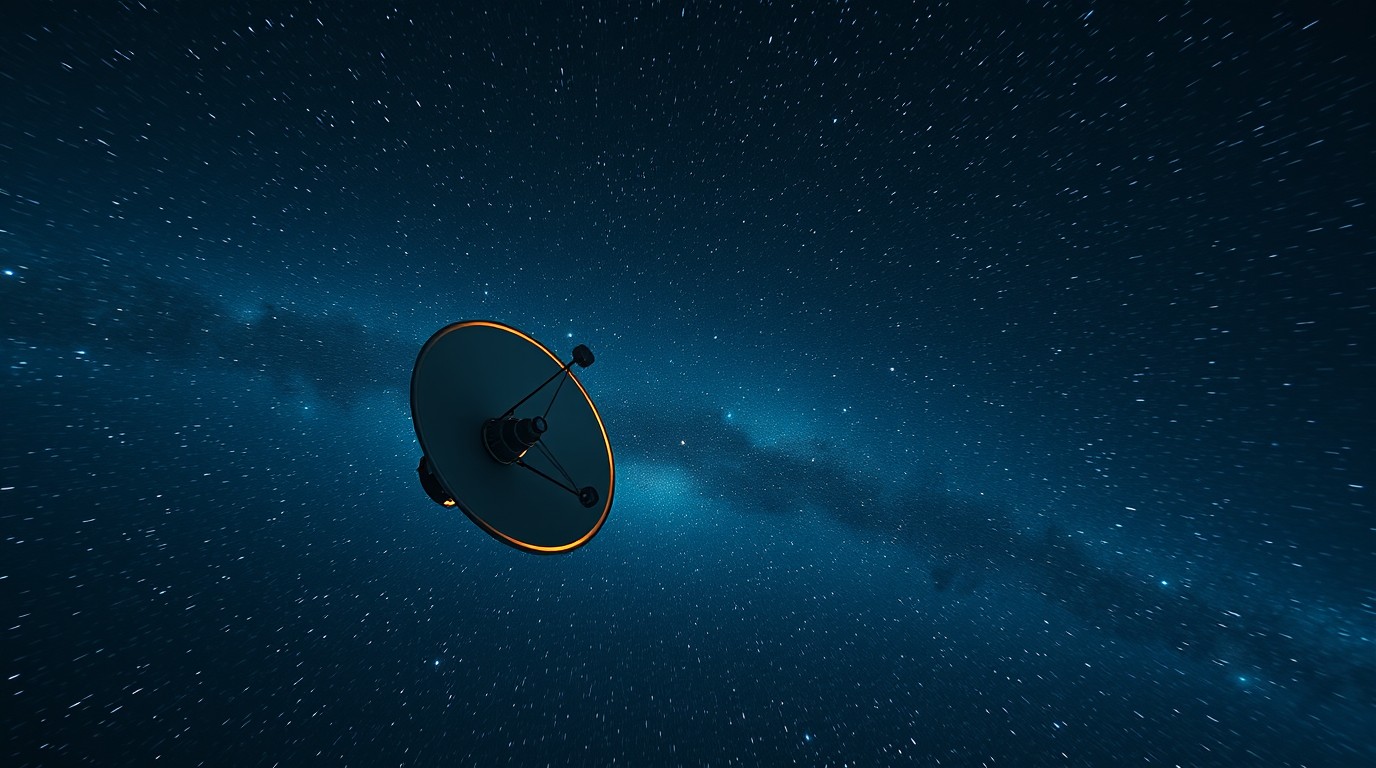
NASA's Voyager 1 probe crossed the threshold of one light-day from Earth on Wednesday, November 18, 2026, when it stood 16,094 million miles (about 25,900 million kilometers) from the planet, according to The Verge. It is the most distant human-made object ever to have traveled.
The crossing was recorded at 5:16 a.m. Eastern Time in the United States, according to The Verge. The craft departed in 1977 with the mission of flying past Jupiter and Saturn, objectives it completed in 1980, and in 2012 it entered interstellar space, Ars Technica recalls. Since then it has continued to send back readings on plasma waves, magnetic fields and particles in space, though today a radio signal takes a full day to reach Earth and another day to return. The figure translates an abstract distance into a measurable unit: light, the fastest messenger in the universe, needs 24 hours to cover that journey. The mission also preserves a cultural record, the golden record with sounds and images of Earth.
Voyager 1 travels at nearly 38,000 miles per hour toward the star Gliese 445, in the constellation Ursa Minor, located 17 light-years away, and the encounter will not occur for some 40,000 years, The Verge reports. Its twin, Voyager 2, launched 16 days earlier, will reach the same one light-day threshold in 2035. In parallel, Ars Technica reports that historian Glen Swanson, former chief historian at NASA's Johnson Space Center, located forgotten copies of the record and a second set of operating instructions; with Jon Lomberg, the record's design director, he is preparing the book Voyager's Golden Record: An Enduring Reflection, which the University of Chicago Press will publish in August 2027.
With the probe still operational at more than 16,000 million miles, every reading its instruments send takes two days to complete the round trip. The next milestone for the Voyager family already has a date: 2035, when Voyager 2 reaches its own light-day.
This article was written with the assistance of artificial intelligence from verified sources and reviewed by a human editor before publication.