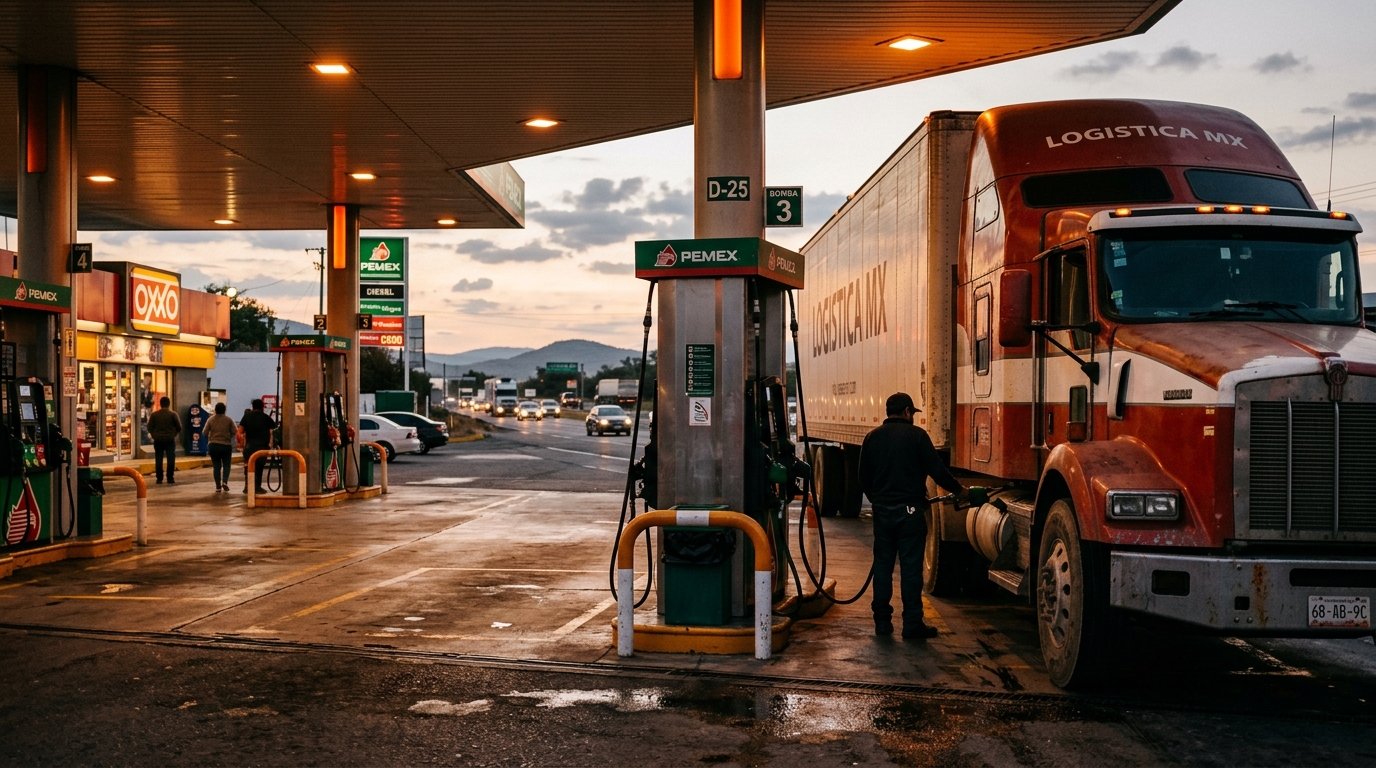
The Mexican government and the majority of the country's gas station operators agreed on Thursday, August 20, to renew for six months the pact that keeps regular gasoline below 24 pesos per liter and diesel below 27. According to Energía a Debate, the National Strategy to Stabilize the Price of Regular Gasoline is being extended for another semester.
The agreement brings together the Secretariats of Energy and Finance and Public Credit (Hacienda y Crédito Público), the Federal Consumer Protection Agency (Procuraduría Federal del Consumidor), Petróleos Mexicanos, the Energy, Safety and Environment Agency (Agencia de Seguridad, Energía y Ambiente), and the National Guard, alongside industry groups including Onexpo, Hidrosina, OXXO Gas, and PetroSeven, according to BNamericas. The strategy, reaffirmed in February 2026 and in effect throughout August, will be formally renewed in the presence of President Claudia Sheinbaum. In border zones, fuel prices will be lower still because of a reduced VAT rate of 8 percent, a provision that directly affects trucking operators and families who cross into the United States. For the binational logistics chain, the current cap provides cost certainty for the coming semester.
The gas station sector acknowledged progress on administrative simplification, combating the illicit hydrocarbons market, reducing card-payment processing fees, and reinforcing public security. In parallel, the Finance Secretariat reactivated the fiscal stimulus on premium gasoline for the week of August 22 to 28, of up to 4 percent per liter, and expanded support for regular gasoline from 16 to 22 percent, according to Bloomberg Línea. Support for diesel rose from 69 to 82 percent, equivalent to approximately 6 pesos per liter. Government and industry representatives will maintain working groups to continue advancing on regulatory simplification, logistics chain strengthening, and operational cost analysis.
The formal renewal of the pact, in the presence of the president, will be the next milestone, and the working groups will continue throughout the semester. While the cap remains in force, the cost of gasoline and diesel stays anchored for households and fleets that keep the economy moving between Mexico and the United States.
This article was written with the assistance of artificial intelligence from verified sources and reviewed by a human editor before publication.