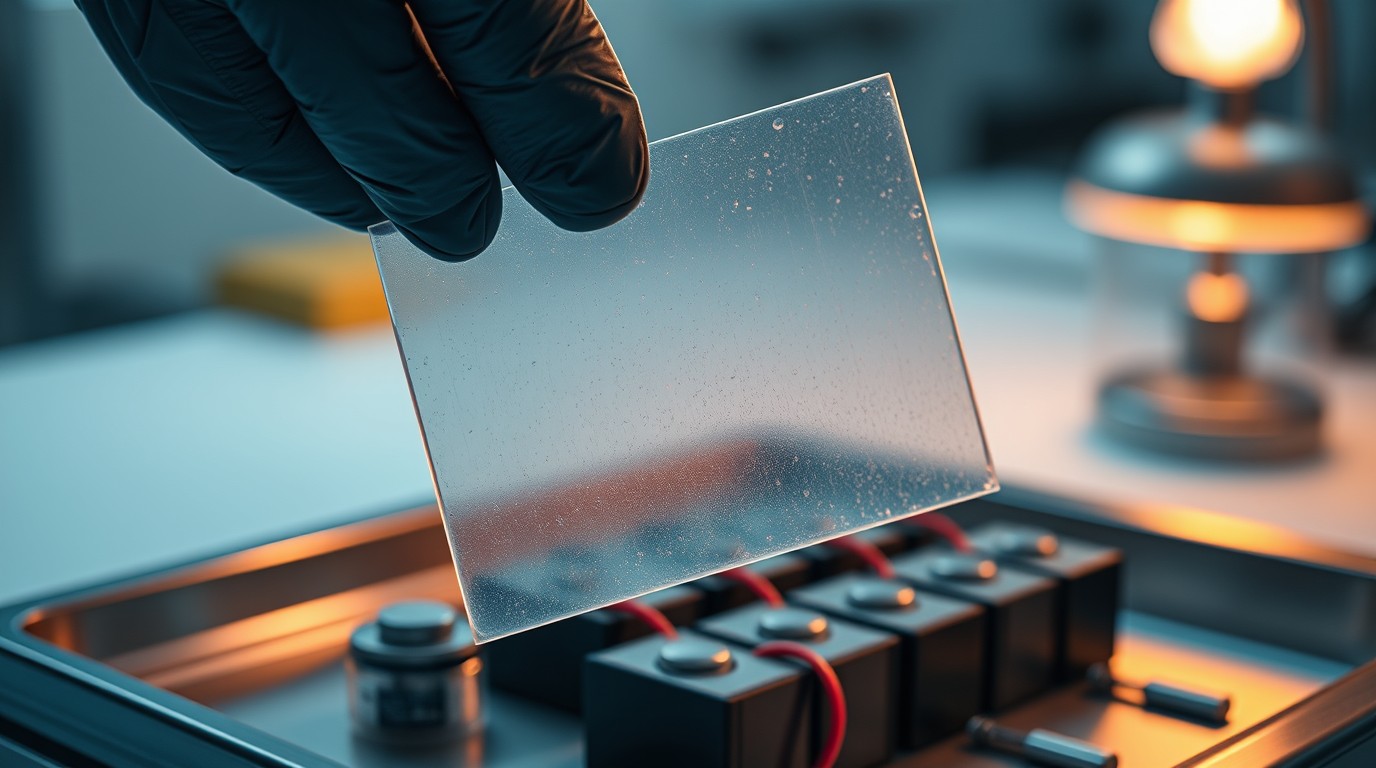
A battery that uses no lithium, is not flammable and reports about 600 watt-hours per kilogram is the result of a team at Politecnico di Milano, announced by the institution on November 9, 2026 and published in the journal Energy Storage Materials. Its foundation is a nearly solid gel membrane that transports fluoride ions at room temperature.
The work is led by Federico Maria Scesa and coordinated by Maurizio Sansotera, of Politecnico di Milano. The cell replaces the lithium electrolyte with a non-flammable polymer membrane, according to Politecnico di Milano. The 600 watt-hours per kilogram is roughly double the 150 to 250 offered by commercial lithium-ion batteries, according to Investigación y Desarrollo. For years, fluoride-ion batteries required operating between 100 and 150 degrees Celsius, an energy cost that held back their progress. For Mexico the finding has a direct reading: the lithium identified in the country is concentrated in Sonora, and storage becomes a mandatory piece of a grid with more solar and wind generation.
The membrane is a nearly solid gel that conducts fluoride ions without heating the cell. "The technology we are developing is based on the use of a non-flammable polymer membrane that reduces the risk of fire and, at the same time, offers the advantage of using an element that is abundant and evenly distributed in nature," Sansotera said. Luca Magagnin, of the same team, specified: "We are talking about about 600 watt-hours per kilogram, compared with the 150-250 watt-hours per kilogram of conventional lithium-ion batteries." Politecnico di Milano describes those 600 watt-hours per kilogram as a theoretical energy density of the material.
The team has not set a commercial date; Politecnico di Milano mentions among the possible uses energy storage, drones, satellites and aircraft. If the performance holds, solar and wind energy storage gains an alternative that does not depend on lithium or on the risk of fire.
This article was written with the assistance of artificial intelligence from verified sources and reviewed by a human editor before publication.