
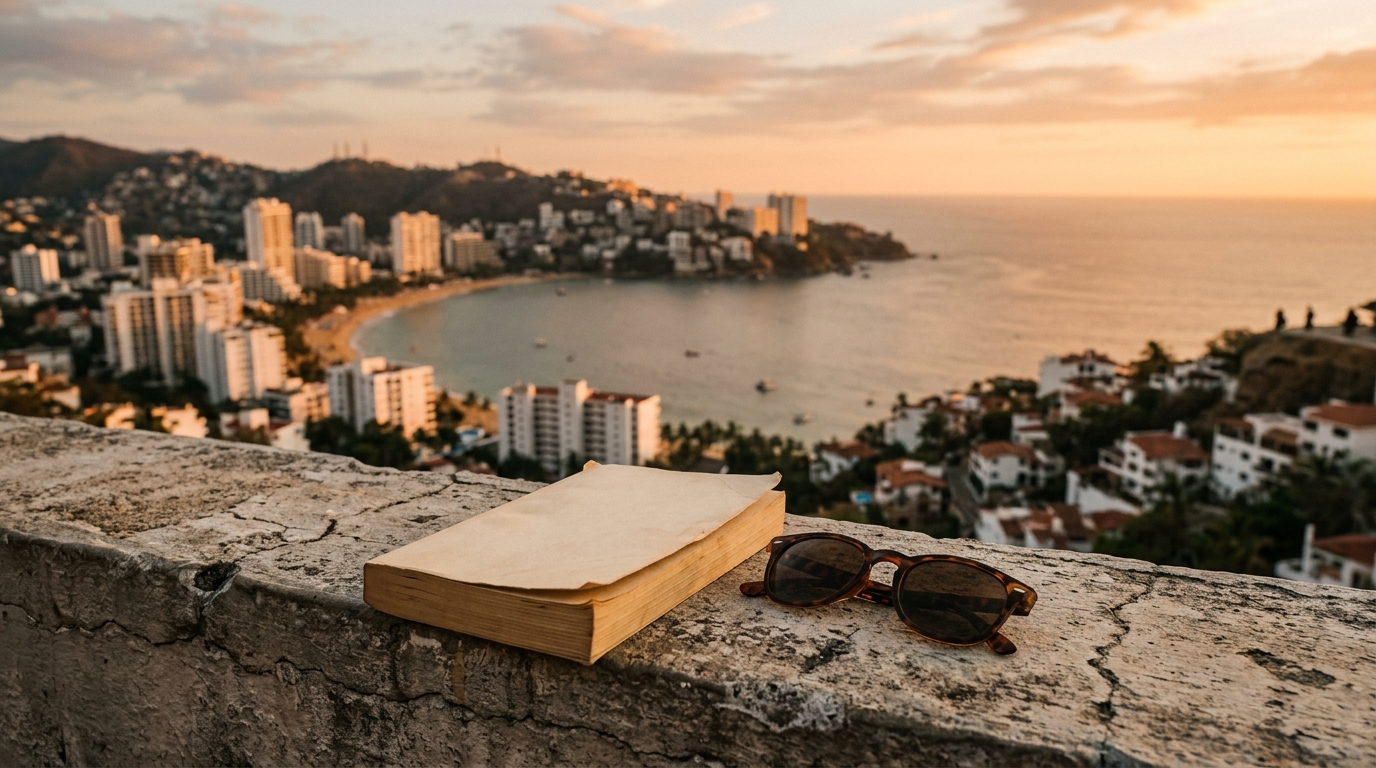
Writer Brenda Ríos published in 2026 Sweet Acapulco. Crónicas y divagaciones del último paraíso en la tierra (Debate), a volume that portrays the Guerrero port as a paradise built at the expense of those who live on its margins. In an interview with El Universal, published on September 13, 2026, the author argues that this destination, the first beach for millions, is also a map of class contrasts.
Ríos, born in Acapulco in 1975, assembled the book over more than a decade, traveling between Mexico City and her hometown. In conversation with La Jornada, she makes clear she is not trying to recapture lost splendor: "I am not trying to build a tourist guide or nostalgically recover lost splendor." The volume, roughly 200 pages, combines family memory, chronicle, and digression, and closes with the sale of the family home as an epilogue. The subject carries concrete resonance for Mexican readers: Acapulco was the first ocean that many generations from the country's center ever saw, a bond the author illustrates by noting that eight out of ten residents of Mexico City and the State of Mexico first encountered the sea through that port.
The author points to geography as evidence. She recounts that a social-housing complex in Caleta was built on slopes with steps, no sea view, and no breeze, to the point that at two in the afternoon residents must turn on the lights: "You tell me if that isn't hostile architecture," she tells El Universal. In the book, the chronicler also examines the relationship between visitors and local businesses, arguing that the paradise was always selective: "paradise is for those who can pay for it, for those who can have a gardener and for those who can have a pool," according to La Jornada. On Hurricane Otis, she states that the disaster revealed "the levels of poverty in which the population lives that you as a tourist never see."
The volume, published by Debate, functions as a biography of the port written from within. Ríos frames it around a contradiction she leaves open: "For me, Acapulco should have already disappeared," she says, while acknowledging that "People are very happy living there." The book lands in bookstores as an invitation to ask for whom the paradise was built.
This article was written with artificial intelligence assistance based on verified sources and reviewed by a human editor before publication.