
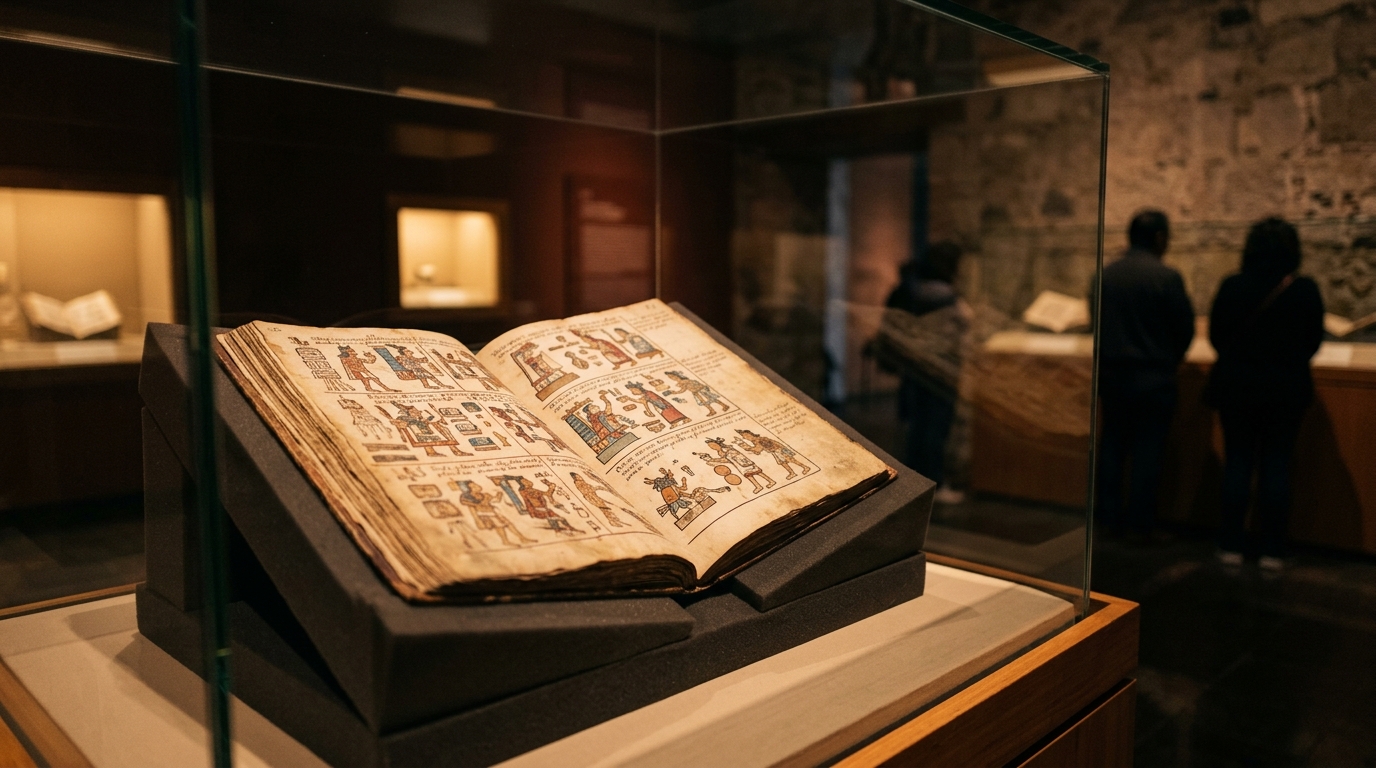
The Azcatitlan Codex, the manuscript that recounts the departure from the mythical island of Aztlán, the journey of its inhabitants and the founding of Tenochtitlan, returned to Mexico and has been on display since September 17, 2026 at the National Museum of Anthropology, on temporary loan from the National Library of France.
The document left the country in 1840 and today forms part of the holdings of the National Library of France. The loan was arranged after the agreement reached by President Claudia Sheinbaum and President Emmanuel Macron in November 2025, within the framework of the bicentennial of bilateral relations. The exhibition, part of the program Mexico-France, 200 Years of Friendship, was organized by Mexico's Ministry of Culture, through INAH, together with France's Ministry of Culture. For the Mexican community at home and abroad, the codex is one of the most detailed visual narratives of the trajectory of the Mexica people.
According to the INAH bulletin, the manuscript, produced in the Valley of Mexico in the late 16th and early 17th centuries, is made up of 20 folios and will remain in the Temporary Exhibition Hall of the National Museum of Anthropology until December 6, with free admission. The exhibition also brings together 25 archaeological and ethnographic pieces organized into six thematic axes, along with facsimiles of nine manuscripts, among them the Bodley, the Boturini and the De la Cruz-Badiano.
The loan revived the debate over definitive repatriation. El Universal reported that Baltazar Brito Guadarrama, curator of the exhibition and head of the National Library of Anthropology and History, noted that so far there is no concrete agreement, that the authority to request an official repatriation rests with the Government of Mexico, and that French and Mexican laws need to be harmonized. Brito considered that the exhibition "is a first step" toward the codex staying permanently. The original request came from the hñähñu community of Ixmiquilpan, Hidalgo, according to the INAH bulletin.
The exchange is reciprocal: while the Azcatitlan is on display in Mexico City, the Boturini Codex traveled to Paris. Conversations between authorities of both countries about a long-term stay continue.
This article was written with the assistance of artificial intelligence based on verified sources and reviewed by a human editor before publication.