The Nobel Assembly at the Karolinska Institute announced on Monday, 5 October 2026, that the Prize in Physiology or Medicine would go to Karl Deisseroth, Peter Hegemann and Georg Nagel for their discoveries about light-activated ion channels and optogenetics, the technique that turns neurons on and off with blue light. The three share 12 million Swedish kronor, close to 1.2 million dollars.
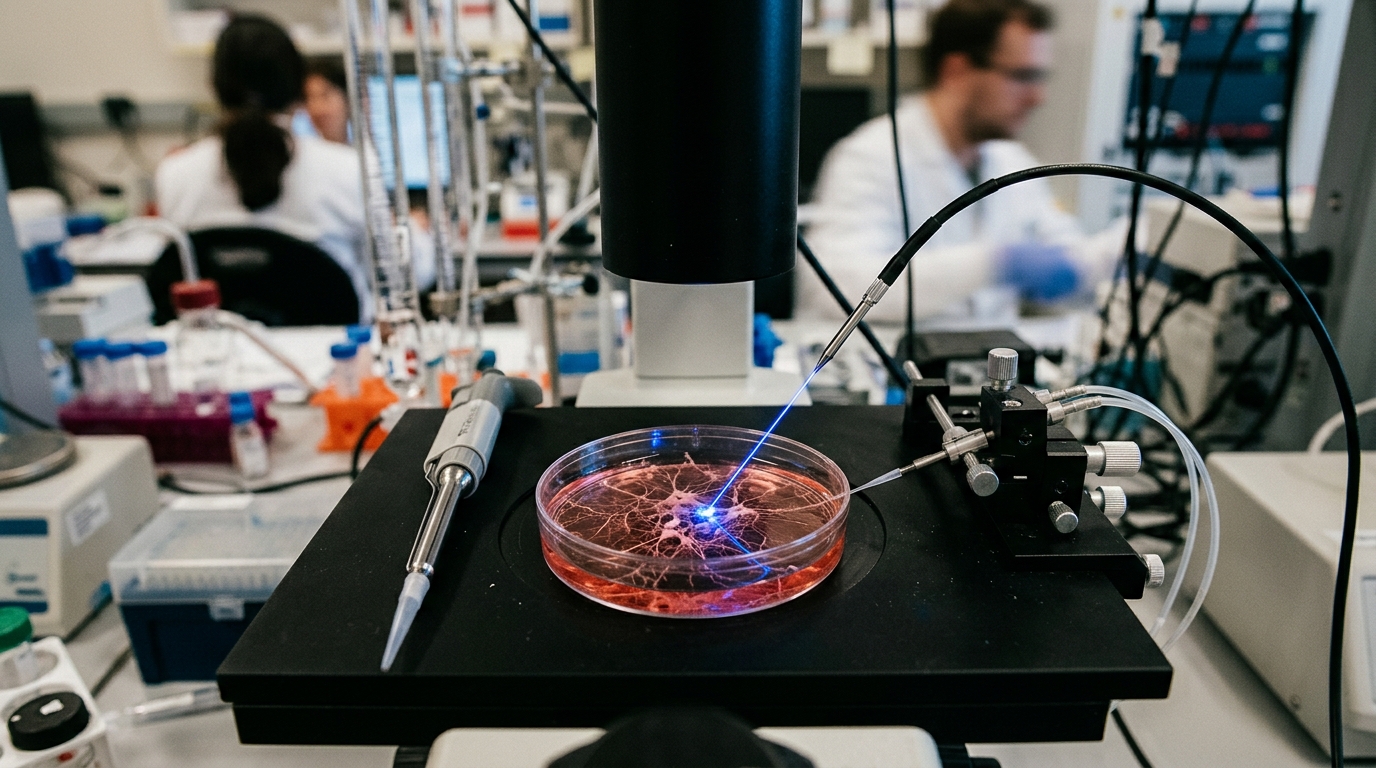
The decision crowns a line of research that began in 2000. Peter Hegemann, a professor at Humboldt University of Berlin, was studying how the microalga Chlamydomonas moves toward light when, together with Georg Nagel, of the University of Würzburg, he identified channelrhodopsin, a protein that opens an ion channel when it receives blue light and produces an electrical impulse. In 2005, Karl Deisseroth, of Stanford University and the Howard Hughes Medical Institute, took that gene into rat nerve cells and managed to fire signals with flashes of light; the method was named optogenetics, from combining light and genes. According to La Jornada, the tool makes it possible to turn specific neurons on and off inside a living brain, something no laboratory could do before.
The Swedish Academy noted that the laureates "have placed a cornerstone in a new era for neuroscience." Per Svenningsson, who chairs the committee for this category, said that "optogenetics can provide opportunities to map the brain in a way that previously could only be dreamed of." Investigación y Desarrollo details that the technique is already used to study Parkinson's, epilepsy, depression, addictions and strokes, and that in clinical medicine it is being tested to improve the vision of people with visual problems. The recognition comes as the tool begins to move out of the laboratory and into patient trials.
The Medicine Nobel opens the week of announcements. Still to come are Physics, Chemistry, Literature, Peace and Economics, whose decisions will be announced in the coming days, and the medals will be awarded on Thursday, 10 December in Stockholm, the anniversary of Alfred Nobel's death.
This article was written with the assistance of artificial intelligence from verified sources and reviewed by a human editor before publication.