
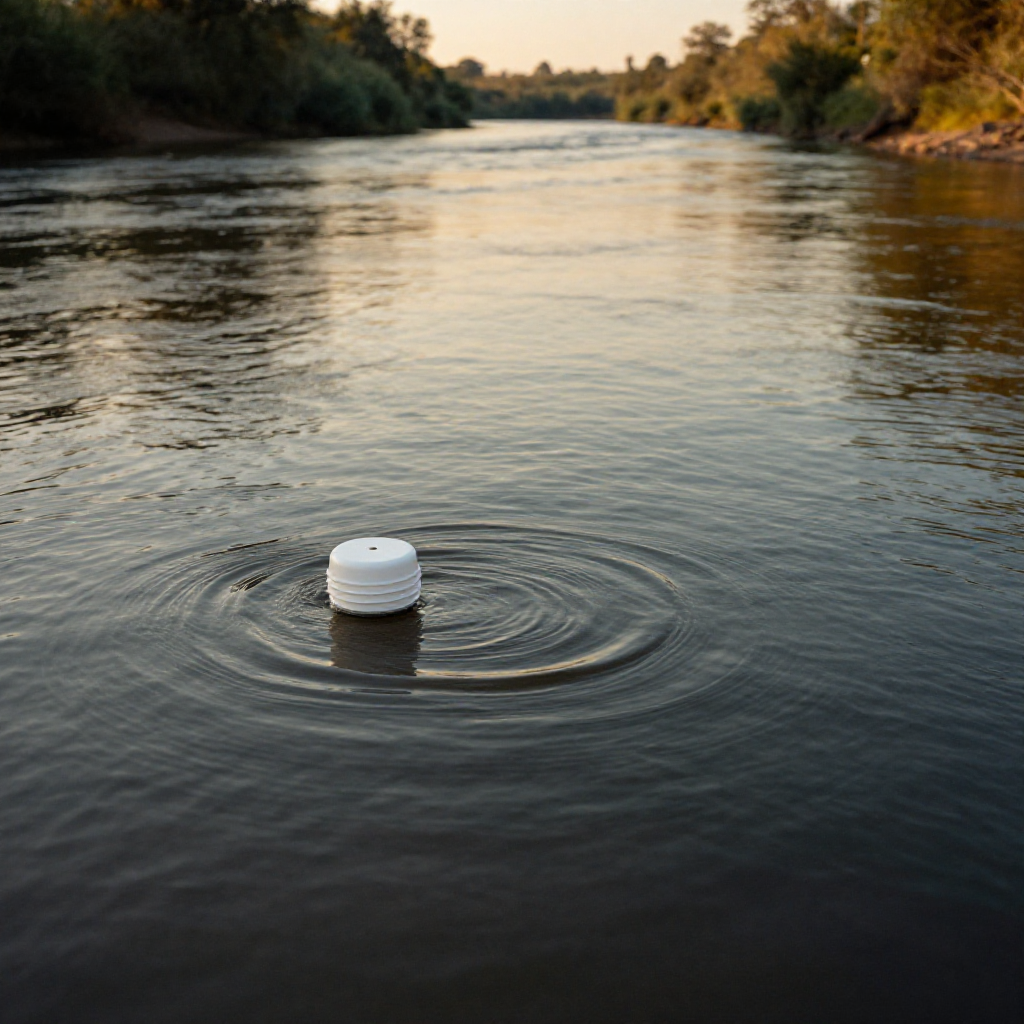
A team at Yonsei University in South Korea has developed a floating capsule that measures water contamination and disinfects it without electricity, batteries or chemicals. The study, published on June 7, 2026 in the journal Nature Water, describes a device that runs on the energy of waves, wind or a person's walking motion.
The capsule brings together three functions that normally require separate equipment: analysis, wireless data transmission and disinfection. When it is shaken for three seconds, an internal magnet moves inside a coil and generates electricity through electromagnetic induction, enough to power a total dissolved solids sensor and a Bluetooth module that sends the reading to a phone. According to the study, the prototype sets the dissolved solids threshold at 250 milligrams per liter: below that mark it considers the water suitable for disinfection. The Research and Development report places that use in rural areas without a stable power grid, isolated communities and emergencies after a natural disaster, a scenario that also describes much of rural Mexico.
The tests were carried out with tap, river and lake water. In one-liter containers, the motion brought the microorganisms studied down to undetectable levels in 20 to 25 minutes. With four liters of river water and only the swell of a light breeze, disinfection was completed in 52 minutes. The researchers report a reduction of up to 99.9999% of bacteria and viruses, and the device maintained its performance over 120 consecutive cycles, with an estimated capacity of at least 480 liters per capsule and a manufacturing cost of close to 25 dollars. The limits are also stated: it does not remove chemical contaminants such as arsenic, pesticides or industrial waste.
For now it is a laboratory prototype, and its authors do not present it as a substitute for conventional water treatment systems. The next step is validation outside the laboratory, in the communities where transporting a full water purification kit is not an option.
This article was written with the assistance of artificial intelligence from verified sources and reviewed by a human editor before publication.