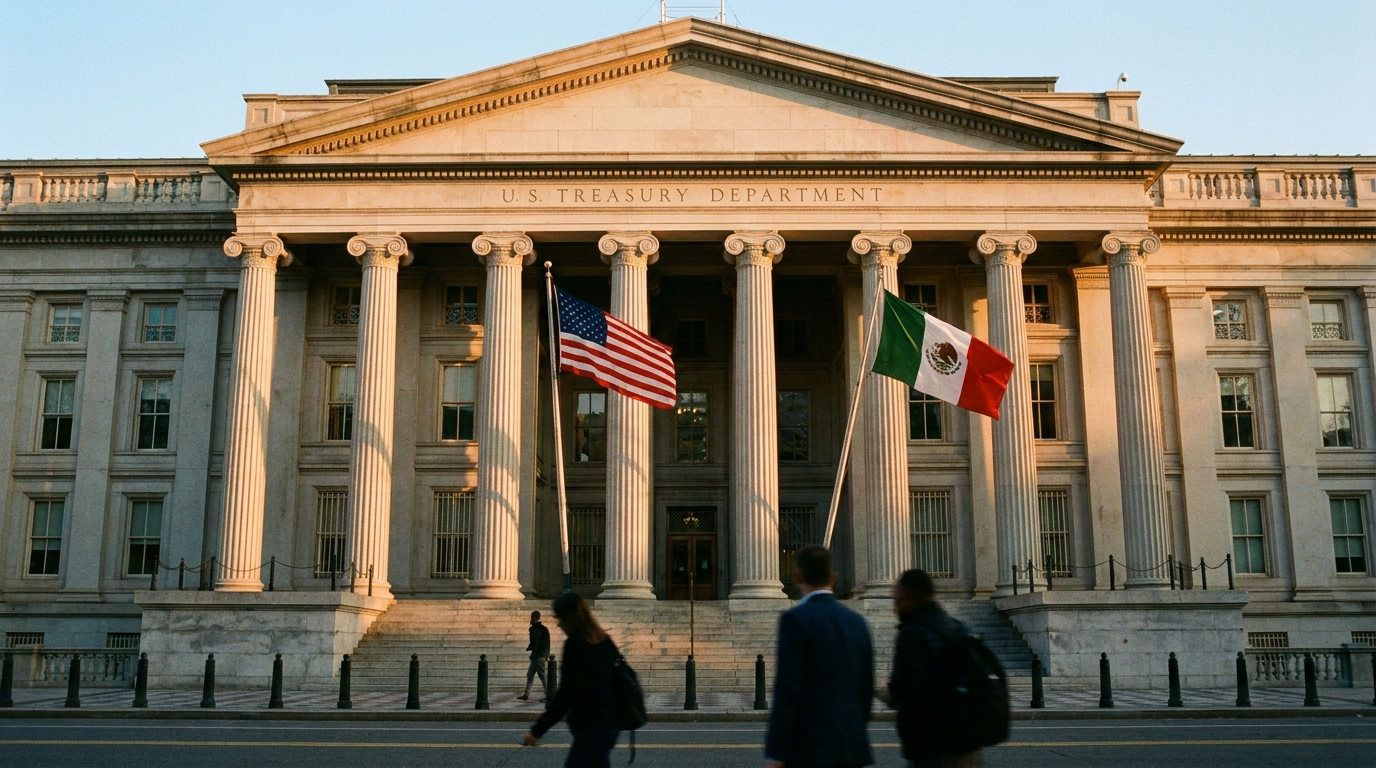
On July 23, 2026, the United States Department of the Treasury and Mexico's Financial Intelligence Unit (UIF) imposed joint sanctions against 39 individuals and 16 companies tied to the financial network of the Jalisco New Generation Cartel (CJNG), in what the Office of Foreign Assets Control (OFAC) described as the largest action of this kind against that organization to date.
The action was carried out under two executive orders: 14059, targeting the international proliferation of illicit drugs, and 13224, directed at organizations designated as terrorists. According to El Universal, OFAC has carried out approximately 30 actions against 250 individuals and entities linked to transnational organized crime. Treasury Secretary Scott Bessent noted that the CJNG is responsible for a significant share of the fentanyl trafficked into the United States, a drug that has affected communities on both sides of the border.
Mexico's UIF added eight additional subjects to its Blocked Persons List (four individuals and four companies) and filed a complaint with the Attorney General's Office (FGR) for the probable commission of money laundering operations. Among those sanctioned is Juan Carlos González, alias "El Pelón," identified by US authorities as the new CJNG leader following the death of Rubén Oseguera Cervantes, "El Mencho." González holds dual Mexican-American citizenship, and the State Department is offering a reward of up to five million dollars for information leading to his arrest or conviction.
According to Proceso, the investigation found that the CJNG has diversified its revenue streams beyond drug trafficking, with operations that include fuel theft and smuggling, as well as timeshare fraud schemes. The US National Security Task Force, which integrates the FBI, Homeland Security Investigations (HSI), and the DEA, participated in the action.
Sanctioned individuals and companies are barred from conducting transactions within the US financial system, and any entity in which they hold at least a 50 percent stake is also blocked. Binational cooperation remains active, and further designations are expected in the coming months as joint investigations into the money-laundering networks of transnational organized crime advance.
This article was drafted with artificial intelligence assistance from verified sources and reviewed by a human editor before publication.