
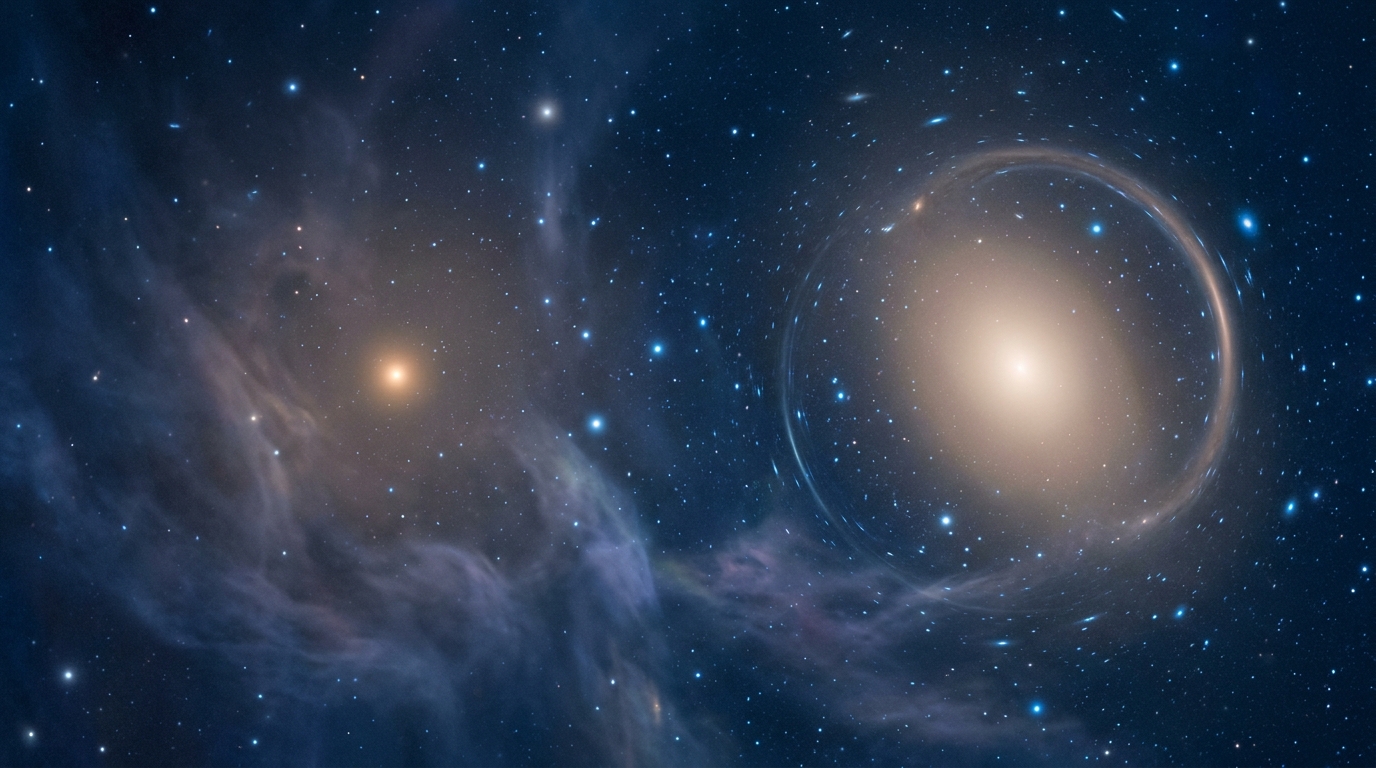
Historic Discovery in the Deep Universe
The James Webb Space Telescope has identified the most distant inactive black hole ever observed, located in the galaxy MRG-M0138 more than 10 billion light-years away. An international team announced the breakthrough in the journal Science, estimating the black hole's mass at roughly 6 billion times that of our Sun. The discovery is forcing astronomers to revise their models of how supermassive black holes grew so quickly in the young universe.
How They Spotted the Invisible
The detection relied on gravitational lensing, a cosmic magnifying glass created by a galaxy cluster positioned between Earth and MRG-M0138. The warping of spacetime amplified the distant galaxy's light by approximately 30 times, enabling researchers to measure stellar velocities near the galactic center with precision and calculate the hidden black hole's mass.
This technique matters because inactive black holes are notoriously hard to detect. Unlike their feeding counterparts, they emit no bright radiation, making them nearly invisible across cosmic distances. Gravitational lensing, predicted by Einstein's General Relativity, has emerged as a crucial tool for probing the deep cosmos.
A Banner Week for Webb
The discovery comes as part of an intense period for the observatory. NASA also released evidence this week of "black hole stars" in the early universe, publishing a study on object GLIMPSE-17775 on June 10 in The Astrophysical Journal. Together, these findings open a window into how black holes and galaxies evolved together during the universe's first billion years.
Relevance for Latin America
Mexico's astronomical community has a stake in this research. Institutions including UNAM's Institute of Astronomy and Institute of Nuclear Sciences participate in international collaborations using Webb, alongside programs involving the Large Millimeter Telescope Alfonso Serrano in Puebla and the National Astronomical Observatory in San Pedro Mártir.
What's Next
Upcoming milestones for Webb include new deep-field observation campaigns and results on potentially habitable exoplanets, scheduled for release by NASA and ESA in coming weeks.
Sources
- https://larepublica.pe/ciencia/2026/06/07/el-telescopio-james-webb-detecta-el-agujero-negro-invisible-mas-lejano-su-masa-equivale-a-6-mil-millones-de-soles-298921
- https://ciencia.nasa.gov/universo/telescopio-webb-de-la-nasa-halla-la-evidencia-mas-solida-hasta-la-fecha-de-estrellas-de-agujero-negro/