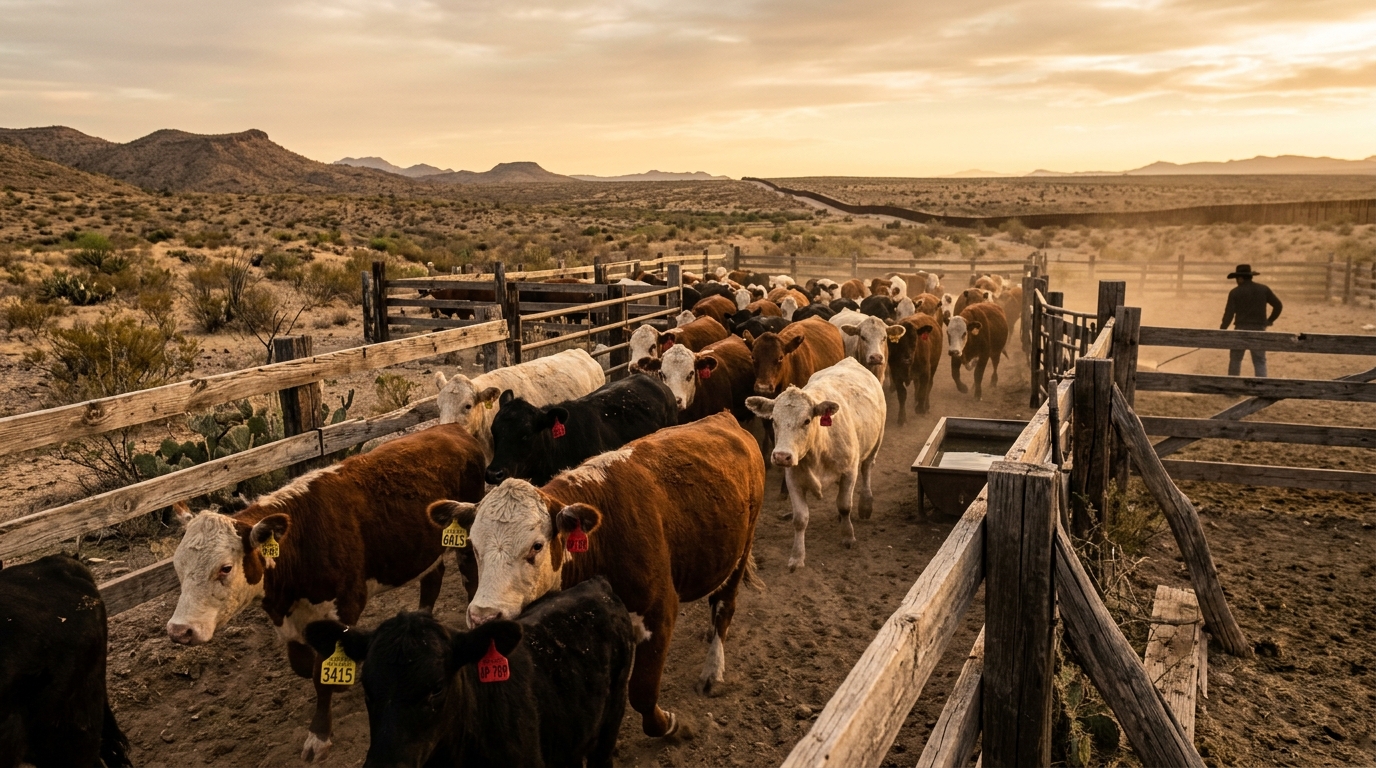
Mexico will resume live cattle sales to the United States on August 24 through the Agua Prieta, Sonora / Douglas, Arizona crossing, under a sanitary protocol that begins with a cap of 700 head per day. The reopening restores certainty for ranchers in northern Mexico, who had been battered by the trade suspension.
The pest, the larva of the Cochliomyia hominivorax fly, arrived in Mexico in November 2024 and is now present in 30 of the 32 states. The country currently reports 1,969 active cases, fewer than half the figure recorded a year ago, according to The Associated Press. Washington suspended purchases of Mexican cattle to prevent the pest from reaching U.S. herds, but has itself reported cases in Texas and New Mexico for the past two months. Before the closure, Mexico exported roughly 1.2 million head per year to the United States, mostly from Chihuahua, Sonora, Tamaulipas, Coahuila, Nuevo León, Baja California, and Durango, according to El Universal. With the border shut, producers sold their cattle on the domestic market at prices nearly 40% below what U.S. buyers had been paying.
The program will scale from 700 head per day in the first week to 900 in the second, and up to 1,300 once flows normalize, Arturo Ruiz, Sonora's head of animal health, told The Associated Press. The protocol includes radio-frequency ear tags, detection arches, and trained dogs deployed for inspection by the U.S. Department of Agriculture (USDA), a framework Mexico accepted. The U.S. herd stands at roughly 86 million head, the lowest level in 75 years, with a shortfall of about 1.2 million that has pushed meat prices higher. For rancher Martín Alfonso Ibarra, the standstill meant a 40% drop in income: "The movie isn't over yet."
Caution persists among producers. Ibarra recalls that Washington suspended purchases on three separate occasions between November 2024 and July 2025. The signal to watch is whether the flow holds its pace, since Ibarra estimates the sale of his 16 calves will not come through until around October.
This article was written with artificial intelligence assistance based on verified sources and reviewed by a human editor before publication.