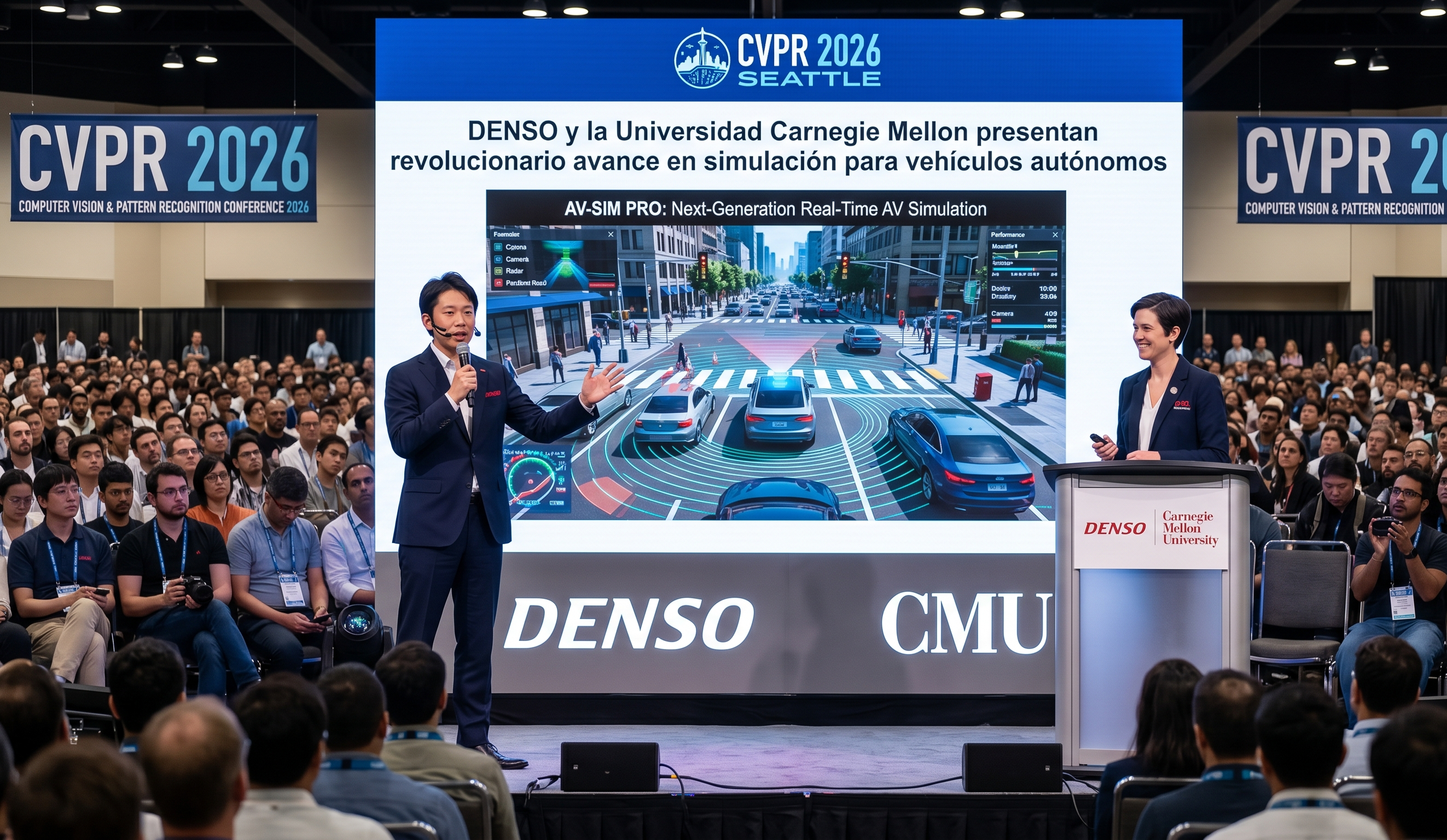
Global mobility supplier DENSO, in close academic partnership with Carnegie Mellon University's (CMU) Robotics Institute in the United States, has announced it will present groundbreaking research in autonomous driving at the prestigious 2026 Conference on Computer Vision and Pattern Recognition (CVPR).
The innovation centers on a methodology called Grounded Latents, which fundamentally reimagines how artificial intelligence models are trained for automated transportation. The approach models driving environments as collections of highly editable individual components, enabling precise control over the behavior of simulated objects, pedestrians, and vehicles.
This new technology tackles the industry's most extreme risk scenarios, known as edge cases, by generating three-dimensional and four-dimensional virtual environments with unprecedented realism and stable backgrounds.
According to DENSO's research and development directors in North America, the ability to accurately simulate real-world traffic trajectories dramatically reduces validation times in physical environments and exponentially increases the safety of integrated systems.
The breakthrough carries direct significance for the North American automotive supply chain. The algorithms refined in these laboratories will form the foundation of vehicle assistance and autonomy systems for years to come.
Sources
- DENSO US-CA Newsroom
- Carnegie Mellon University Robotics Institute
- IEEE/CVF CVPR 2026 Conference Open Access
- Computer Vision Foundation